
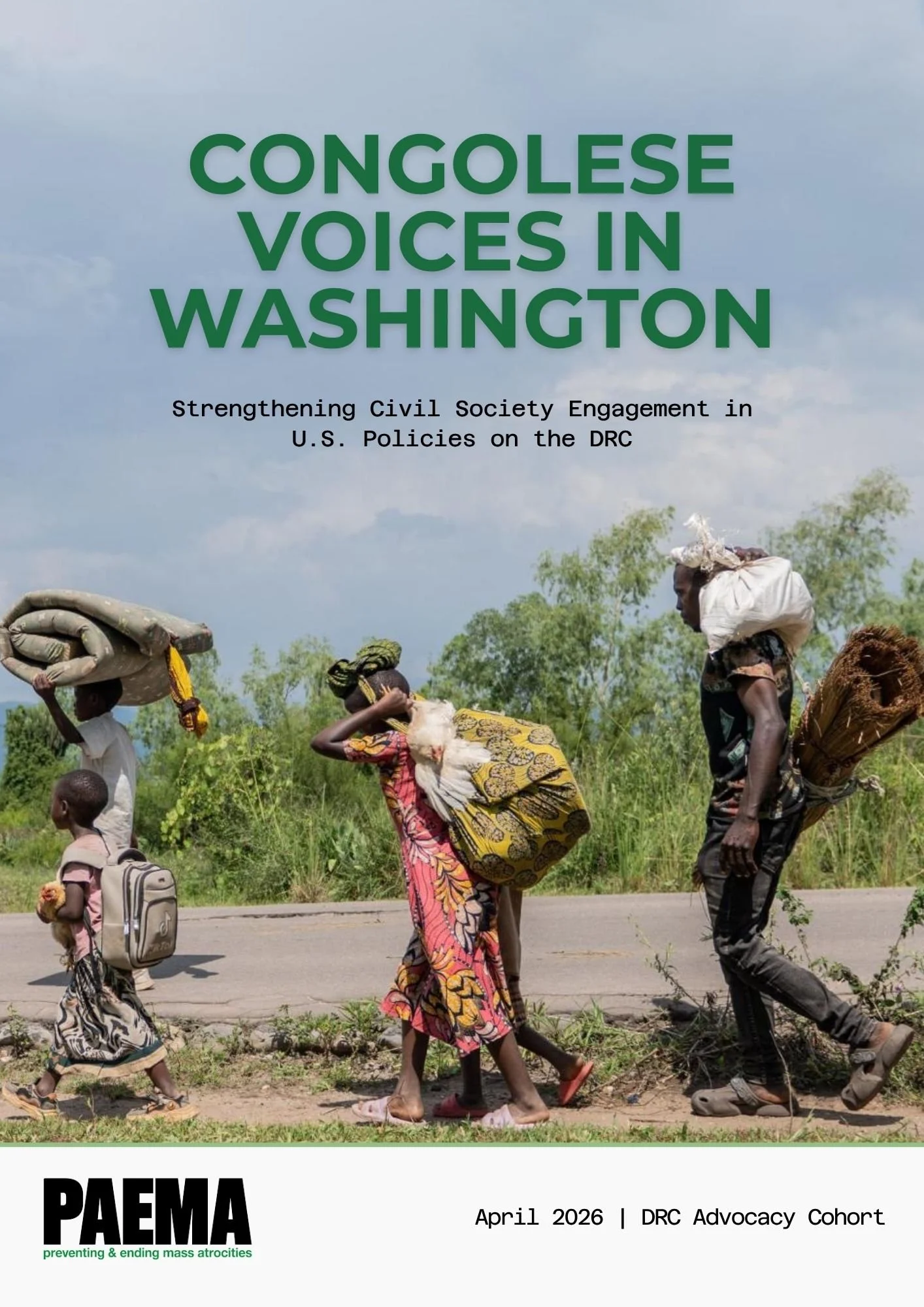
Congolese Voices in Washington: Strengthening Civil Society Engagement in U.S. Policy on DRC
16 April 2026 Today, the PAEMA DRC Advocacy Cohort publishes its white paper titled Congolese Voices in Washington: Strengthening Civil Society Engagement in U.S. Policy on the DRC. Fifteen months into an intensified conflict in eastern DRC, successive peace processes from Nairobi to Luanda to Doha have delivered limited results, while minerals deals and investment agreements, from Chemaf to KoBold, have advanced rapidly. This divergence is unfolding amid a severe humanitarian crisis, with more than 6.9 million Congolese internally displaced. For affected communities, the message is clear: decisions are moving forward without them. No diplomatic process or economic partnership can deliver durable outcomes if disconnected from ground realities. The inclusion of Congolese civil society is not optional; it is essential.
This white paper reflects the experience of the Cohort over the 2025 - 2026 period, drawing on direct engagement with U.S. policymakers. It distills lessons from these interactions and highlights the structural barriers that continue to limit meaningful participation.
“Ignoring civil society is condemning peace agreements to remain fragile declarations of intent, incapable of breaking the cycle of armed violence. Civil society must be an active stakeholder, both upstream of any agreement and downstream in its implementation.” - Jean Chrysostome Kijana, Coordinator of the Pamoja Kwa Amani Coalition and contributing author
“The renewed momentum around critical minerals is reshaping engagement with the DRC at a speed that peace processes have not matched. Without the systematic inclusion of Congolese civil society, policy and investment decisions risk advancing without addressing the drivers of instability on the ground.” - Ornella Nsoki, PAEMA’s DRC Program Manager
The white paper identifies four structural findings that shape any meaningful future engagement and concludes with a set of practical recommendations addressed to the U.S. Congress and executive branch, to international partners, and to Congolese civil society itself. Among the recommendations highlighted here:
Structured diaspora-ground connectivity: establishing regular coordination between Congolese diaspora organizations active in Washington and civil society actors on the ground, to ensure that advocacy remains anchored in community realities.
Recurrent and diversified CSO consultations: moving from one-off engagements to sustained consultation mechanisms that include a broader range of actors, with systematic use of virtual formats to overcome visa and access barriers.
Protection and funding for documentation actors in exile: establishing dedicated support mechanisms for human rights defenders, especially for those forced into prolonged exile, who remain central to documenting violations but now fall outside existing funding frameworks.
Coordinated advocacy messaging: strengthening alignment across civil society and diaspora actors to ensure coherence and avoid fragmentation that weakens influence in international decision-making spaces.
We are approaching the limits of the current approach. The path forward requires inclusion, not closed-door arrangements.
For general inquires, contact Ornella Nsoki, DRC Program Manager at onsoki@paema.ngo