|
$$PLAIN_TEXT_PREVIEW$$
News Monitor #3
SEPTEMBER 2025
|
|
If you were forwarded this email, you can subscribe here.
|
NEWS ROUNDUPUpcoming Elections: The junta stepped up its publicity campaign to legitimize the upcoming elections, widely denounced as a sham. UN High-Level Conference: The Rohingya crisis was discussed in a one-day high-level conference in New York, but it remains unclear if the event revitalized the international community to take more concerted action to address political and humanitarian challenges. Armed Conflict: Fighting continued around the country throughout September, with junta forces launching hundreds of airstrikes but failing to counter advances by rebel forces in many regions. Conference Reflections: PAEMA released a reflections paper, following the high-level conference in New York, calling for action on aspects of the Rohingya crisis where immediate progress is possible.
|
HUMAN RIGHTSAccording to a leaked file, the Chinese internet censorship system Tiangou Secure Gateway (TSG) was installed in Myanmar at the behest of the military junta by a Chinese technology company affiliated with the Great Firewall of China. The system can even track users using VPNs. The Independent Investigative Mechanism on Myanmar (IIMM) launched its report on the seizure and demolition of Rohingya lands and villages during the 2017 clearance operations. Defend Myanmar Democracy and Myanmar Internet Project along with victim’s family members have taken the first step towards suing Norwegian telecoms giant Telenor for their role in serious human rights violations in Myanmar by disclosing sensitive customer data to the junta that was used to track, detain, torture, and kill activists and other civilians.
|
ARMED CONFLICTAccording to new research by the Myanmar Defense and Security Institute, the junta recruited more troops than previously assumed, training up to 5,000 new recruits per month over the past several months. In comparison, the number of defectors may be smaller than previously assumed. The National Unity Government said there had been 500 military airstrikes over the previous month. Rakhine: At least 19 students were killed in a military airstrike in Kyauktaw Township. Sagaing: People’s Defense Forces attacked a police station in Kanbalu township on September 17, capturing five policemen. The Public Defense Organization of Intao Township (PKAFA) announced the indefinite closure of the Intao-Van Mauk Road on the Kachin State border. PDF troops captured Bham Mauk town on September 20. Monywa: Eight soldiers were killed and weapons seized in the attack and occupation of the military base station gate on the Monywa-Mandalay road by PDFs. Kachin: At least 17 people were killed in a military bombing of a Kachin Independence Army (KIA) battalion in Shwegu Township on September 18, though junta propaganda channels claimed that up to 50 had been killed. In Phakant Township, junta troops entered and seized control of some villages in KIA-controlled territories. A church in Diem So Township was bombed by military aircraft on September 18. Yangon: In East Dagon, urban PDF fighters carried out a grenade attack on a local administrative office. Tanintharyi: A military convoy coming from Dawei City to Long Lon City was intercepted and attacked, and the army retreated due to damage from the army side. In Dawei on September 17, Myanmar forces dropped more than 50 bombs on at least ten villages, killing two and critically injuring five. General Min Aung Hlaing traveled to Dawei the following day. The army blocked all roads into the city, thousands of security forces were stationed throughout the city, and armored vehicles roamed the streets while the Dawei River was patrolled by warships.
|
U.S AND INTERNATIONAL DIPLOMACYPresident Trump added Burma (Myanmar) to a list of major drug-producing and transit countries, declaring that these countries threaten U.S. national security. The U.S. declared that Myanmar was "significantly likely to have failed" to comply with international anti-narcotics agreements and meet the requirements of Section 489(a)(1) of the Foreign Assistance Act within the previous 12 months, with potential consequences on humanitarian assistance. The U.S. Department of Treasury Office of Foreign Assets Control (OFAC) implemented sanctions against scam operators across Southeast Asia, including in Shwe Kokko, Myawaddy Township in Kayin State. General Min Aung Hlaing met with Russian President Vladimir Putin in Moscow, reasserting bilateral cooperation. A planned visit of ASEAN foreign ministers to Myanmar was postponed or canceled after Min Aung Hlaing indicated that he would not meet with them to discuss the upcoming December elections. Min Aung Hlaing attended the Shanghai Cooperation Organization (SCO) Summit in China, meeting with leader Xi Jinping and India’s Narendra Modi. The visit was Min Aung Hlaing’s second since the 2021 military coup.
|
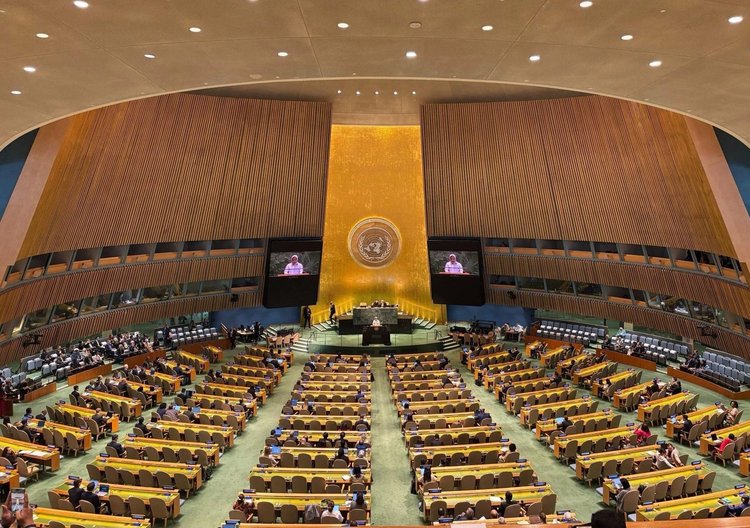
ROHINGYA CRISIS AND REGIONAL DYNAMICSThe High-Level High-Level Conference on the Situation of Rohingya Muslims and Other Minorities in Myanmar on September 30 convened dignitaries, heads of UN agencies, Rohingya community representatives, and a plenary of member states and international civil society organizations to discuss the ongoing crisis and highlight urgent priorities demanding international attention and sustained progress. The conference was criticized for failing to bring Rohingya refugees from the camps, though two of the four speakers from the community lived in the camps for several years before resettling in the U.S. Observers also questioned whether the conference built sufficient momentum to spark concrete action. Humanitarian funding pledged by the U.S., the UK, and others will extend the fragile aid lifeline for refugees in Cox’s Bazar, though the Joint Response Plan remains severely underfunded. The US announced a $60 million pledge for food assistance but called on other countries to give more and for Bangladesh to grant refugees the right to employment. An estimated 150,000 Rohingya have fled to Bangladesh since mid-2024 amid heavy fighting and alleged human rights abuses against the Rohingya by the AA, including extrajudicial executions, torture, forced labor and large-scale arson. However, an Irrawaddy article claimed that positive changes had taken place regarding the AA’s management of Rohingya rights. On August 25, Bangladesh’s interim leader, Muhammad Yunus, spoke at an international conference in Cox’s Bazar about the moral duty to stop the ethnic cleansing of Myanmar’s Rohingya minority. Yunus called for their “early, voluntary, and sustainable” return to Myanmar.
|
DOMESTIC POLITICSDespite counter-offensives to recapture territory before the elections, the junta announced on September 14 that elections could not be held in 56 townships controlled by revolutionary forces in the first round of the upcoming elections, planned for December 28. AA chief Tun Myat Naing met with Rohingya in Maungdaw and reopened the Jamay Mosque, which had been closed for 13 years. Several political parties were barred from participation in the upcoming election, widely seen as a sham and which anti-junta advocates are urging the international community to denounce. The U.S. announced that it “rejects these elections under current conditions.” The junta has begun to imprison civilians who criticize the election process, including a Taungyyi man sentenced to seven years of hard labor under the new “General Election Protection Law,” enacted in July.
|
BUSINESS, TRADE & NATURAL RESOURCESAs the rare earth competition between India, Pakistan, and China intensifies, Reuters reports on a rare effort by India to engage the Kachin Independence Army (KIA), which controls areas rich in rare earth deposits.
|
|
If there is anything specifically you would like to see from this newsletter or if you have any feedback, we would love to hear from you. Please write to us at info@paema.ngo info@paema.ngo
|
|
|
|