|
$$PLAIN_TEXT_PREVIEW$$
News Monitor #4
26 June 2025Le bulletin dans son intégralité en français est disponible sous la version anglaise.
|
|
If you were forwarded this email, you can subscribe here. // Si ce mail vous a été transféré, vous pouvez vous abonner ici.
|
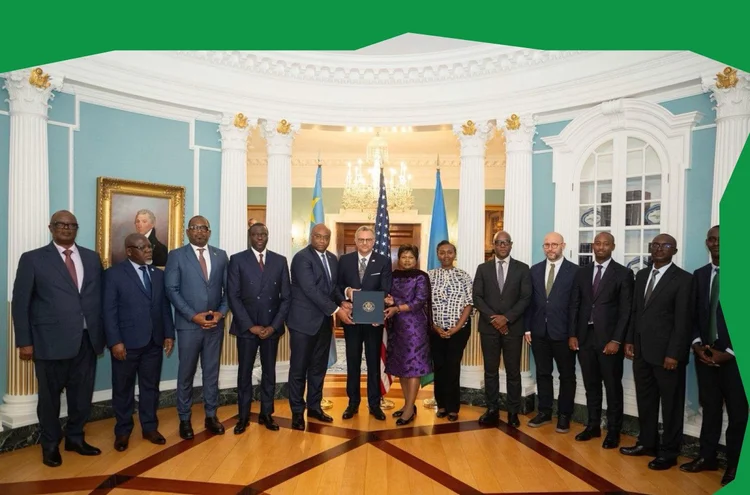
DRC NEWS ROUNDUPBintou Keita, the head of MONUSCO, met on 13 June with M23 leaders in Goma, the first meeting between MONUSCO and M23 representatives since M23 seized Goma in January 2025. The stated goal of the meeting was to ‘establish contact’ and discuss ways to ensure the protection of civilians. Following peace talks in Washington, DC between representatives of the Congolese and Rwandan governments, mediated by the U.S. and observed by Qatar, a joint statement was released on 18 June announcing plans for the foreign ministers of DRC and Rwanda to sign a peace agreement on 27 June. The ICRC is warning that the health care systems of North and South Kivu provinces are on the verge of collapse, with significant increases in the number of wounded people (172%) and victims of armed and sexual violence in need of psychosocial support (seven fold) compared to 2024.
|
HUMAN RIGHTSDozens of Congolese civilians are still sheltered in Goma’s MONUSCO base, five months after M23 took control of the city, with no evacuation plan in sight. MONUSCO head Bintou Keita, on a visit to Goma, said their evacuation could only come once a compromise was reached between M23 and the Congolese government. ADF rebels killed at least 35 civilians during an attack on 7 June in Lubero territory, Nord-Kivu province. Wazalendo militants in South Kivu are targeting Banyamulenge civilians, due to their purposed association to Rwanda and M23. Speaking at the Human Rights Council, UN High Commissioner for Human Rights, Volker Türk, said that human rights violations in eastern Congo could amount to war crimes. Although the UN’s Human Rights Council launched a Fact-Finding Mission in February to be followed by an independent Commission of Inquiry to investigate abuses committed by all parties to the conflict, Türk announced that due to the UN’s financial crisis, setting up the Commission of Inquiry would likely be delayed until 2026.
|
ARMED CONFLICTThe Congolese armed forces (FARDC) have received more than 100 new armored vehicles supplied by the UAE company International Golden Group. Several of these vehicles are intended to be deployed in the eastern provinces; a military source speaks of a ‘quantum leap in the army’s response capabilities against increasingly structured enemies’. FARDC are also adding Turkish drones to their arsenal. Uganda and the DRC have formally extended their joint operations (‘Operation Shujaa’) in eastern DRC during a high-level bilateral meeting in Kinshasa with a Ugandan delegation led by General Muhoozi Kainerugaba, Uganda’s Chief of Defence Forces (and the Ugandan president’s son). The renewed MoU allows for the expansion of the intervention zones to the Mambasa territory in Ituri province. Observers suggest that Uganda’s military operations in DRC may be driven by economic interests. FARDC are still fighting against Thomas Lubanga’s recently-created CRP (Convention for the People’s Revolution) in Ituri province, who has formed an alliance with the Zaire militia. Clashes between M23 and Wazalendo are ongoing in North Kivu and South Kivu (especially around Bukavu), where civilians are suffering from the fallout of fighting.
|
DEVELOPMENT AND HEALTHThe ICRC is warning that the health care systems of North and South Kivu province are on the verge of collapse in an alarming report. The organization points out, for example, a fourfold increase in stillbirths; and a 172% rise in the number of wounded people treated in its hospitals in the first quarter of 2025 compared to the same period in 2024. MSF reports an alarming number of victims of sexual violence, treating more than 7,400 patiens between January and April 2025 in Goma. Civil society is warning of looming famine in Kalehe territory, South Kivu, due to reduced agricultural production caused by ongoing conflict and adverse climate conditions.
|
DISPLACEMENTCongolese refugees in Rwanda have been quietly returning to the DRC, without any oversight from UNHCR or the Rwandan ministry in charge of refugees. According to staff at the Mahama camp, more than 80% of Congolese refugees have left some of the camp’s villages—some reportedly with the intention of joining M23. Human Rights Watch denounces what M23 refers to as repatriation of refugees to Rwanda (see last newsletter) as ‘forced transfers’ and ‘deportations’, in violation of the 1949 Geneva Conventions.
|
PEACE PROCESSESAs the anticipated signing of a peace agreement between DRC and Rwanda representatives approaches on 27 June,, following negotiations mediated by the U.S.,, the ‘Pamoja Kwa Amani’ (Together for Peace) civil society consortium issued a press release calling on specific measures to alleviate civilian suffering.
|
DOMESTIC POLITICSAfter the National Assembly authorized the public prosecutor at the Court of Cassation to bring charges against him, the Minister of Justice, Constant Mutamba, announced his resignation and denounced a ‘political plot orchestrated by Kigali’.
President Tshisekedi met with representatives of the Catholic and Protestant Churches on 21 June, who have been advocating for a nation-wide dialogue to put an end to the ongoing crisis in eastern DRC. Relations between the Presidency and the religious leaders had been tense since their meeting with M23 leadership in Goma earlier this year. The meeting resulted in the establishment of a presidential task-force in charge of exploring the proposed dialogue initiative.
|
BUSINESS, MINERALS & INFRASTRUCTURE
|
GREAT LAKES AND REGIONAL DYNAMICSBurundi’s ruling party, CNDD-FDD, won all seats in the 5 June legislative elections, a vote that observers and opposition parties claim was marred by irregularities. Rwandan authorities have arrested leading opposition figure Victoire Ingabire on 19 June, accusing her of ‘criminal association and public incitement to oppose the government’.
|
REPORTING AND ANALYSISAn analysis by ACLED on Allied Democratic Forces (ADF) violence reveals how the group has taken advantage of the Congolese military’s focus on M23 to carry out mass killings against civilians and further entrench its presence in the territories it claims to control. A Foreign Affairs piece authored by Joshua Walker, Reagan Miviri and Jason Stearns explores whether U.S. diplomacy could actually help bring peace to the DRC. IPIS published a piece analyzing M23’s territorial advances in May, underlining the disconnect between the ongoing peace processes and negotiations and the reality on the group. In the New Left Review, Jason Stearns examines the causes of the crisis in the East, surveying ‘the desire of neighboring countries to project power and influence in the DRC; the crippling weakness of the Congolese state; and the relationship between the current crisis and the world economy’. IRIS published a report on the potential and current realities of the Lobito Corridor, highlighting the numerous technical, political, and social barriers that continue to hinder its implementation. The report outlines that fully realizing the project will require not only significant infrastructure development but also the resolution of deeper structural challenges.
|
U.S. AND INTERNATIONAL DIPLOMACYPresident Tshisekedi is attending the U.S.-Africa Business summit in Luanda, where he is expected to meet with Massad Boulos, President Trump’s Special Adviser on Africa, and deliver a presentation on the Lobito corridor. Joseph Kabila has sent an emissary to D.C., tasked with pleading his cause to American authorities, members of Congress and of the National Security Council. A recent op-ed in Newsweek calls on the NBA not to partner in Rwanda due to its role in the DRC conflict, denouncing ‘sportswashing’. The U.S. embassy in Kinshasa launched a new PR campaign, “Bâtir l’avenir ensemble” (Build the Future together) and reopened the American Center in Gombe, Kinshasa.
|
|
If there is anything specifically you would like to see from this newsletter or if you have any feedback, we would love to hear from you. Please write to us at drcnews@paema.ngo or leave a comment through this anonymous form.
|
EN BREFBintou Keita, cheffe de la MONUSCO, a rencontré le 13 juin les représentants du M23 à Goma, marquant la première réunion entre la mission onusienne et la milice depuis la prise de Goma par le M23 en janvier 2025. Objectifs annoncés : « établir un contact » et discuter des moyens d’assurer la protection des civils. À la suite de pourparlers de paix à Washington entre des représentants des gouvernements congolais et rwandais, sous médiation américaine et supervision qatarie, un communiqué conjoint publié le 18 juin annonce la signature prévue d’un accord de paix par les ministres des Affaires étrangères du Rwanda et de la RDC le 27 juin. Le CICR alerte sur l’effondrement imminent des systèmes de santé au Nord et Sud-Kivu, signalant une augmentation de 172 % des blessés pris en charge dans leurs centres et une multiplication par sept des victimes de violences sexuelles sexuelles nécessitant un soutien psychosocial par rapport à 2024.
|
HUMANITAIRELe CICR avertit que les systèmes de santé au Nord et Sud-Kivu sont en état d’effondrement. On note, entre autres, une multiplication par quatre des mort-nés et une hausse de 172 % des blessés traités au premier trimestre 2025 par rapport à la même période en 2024. MSF rapporte avoir traité plus de 7 400 victimes de violences sexuelles entre janvier et avril 2025 à Goma et rapporte des niveaux “alarmants” de violences sexuelles. La société civile alerte sur une famine imminente dans le territoire de Kalehe (Sud-Kivu), en raison de la baisse de la production agricole causée par les conflits et les conditions climatiques.
|
PROCESSUS DE PAIXAlors que la signature attendue d’un accord entre la RDC et le Rwanda est prévue pour le 27 juin, à l’issue d’une médiation américaine, le consortium « Pamoja Kwa Amani » (Ensemble pour la paix) appelle à des mesures concrètes pour alléger les souffrances des civils.
|
POLITIQUE INTÉRIEURELe ministre de la Justice, Constant Mutamba, a annoncé sa démission après que l’Assemblée nationale a autorisé le procureur près la Cour de cassation à engager des poursuites contre lui, dénonçant un « complot politique orchestré par Kigali ». Le président Tshisekedi a rencontré le 21 juin les représentants des Églises catholique et protestante, favorables à l’organisation d’un dialogue national pour résoudre la crise dans l’Est. Cette rencontre, après des mois de tensions liées à la visite des religieux au M23, a conduit à la création d’une cellule présidentielle chargée d’examiner l’initiative de dialogue.
|
BUSINESS, MINERAIS ET INFRASTRUCTURES
|
GRANDS LACS ET DYNAMIQUES RÉGIONALESLe parti au pouvoir au Burundi, le CNDD-FDD, a remporté tous les sièges lors des élections législatives du 5 juin, un scrutin entaché d’irrégularités selon les observateurs et l’opposition.
|
RAPPORTS ET ANALYSESACLED publie une analyse montrant comment les ADF ont profité de la focalisation militaire congolaise sur le M23 pour intensifier les massacres de civils et renforcer leur implantation territoriale. Dans Foreign Affairs, Joshua Walker, Reagan Miviri et Jason Stearns examinent le rôle que pourrait jouer la diplomatie américaine dans la recherche de paix en RDC. L’IPIS analyse les avancées territoriales du M23 en mai, soulignant le décalage entre les processus de paix et la réalité militaire sur le terrain. Dans la New Left Review, Jason Stearns explore les causes profondes de la crise dans l’Est, incluant l’ingérence des pays voisins, la faiblesse de l’État congolais, et le lien avec l’économie mondiale. L’IRIS publie un rapport sur les enjeux du corridor de Lobito, évoquant les obstacles techniques, politiques et sociaux qui freinent sa mise en œuvre, et appelant à un traitement des défis structurels de fond.
|
DIPLOMATIE INTERNATIONALE ET AMÉRICAINELe président Tshisekedi participe actuellement au U.S.-Africa Business Summit à Luanda, où il doit rencontrer Massad Boulos, conseiller spécial du président Trump pour l’Afrique, et présenter le projet du corridor de Lobito. Joseph Kabila a envoyé un émissaire à Washington pour plaider sa cause auprès des autorités américaines, du Congrès et du Conseil de sécurité nationale. Une tribune parue dans Newsweek appelle la NBA à cesser toute coopération avec le Rwanda, en raison de son implication dans le conflit en RDC, dénonçant une opération de « blanchiment sportif ». L’ambassade des États-Unis à Kinshasa a lancé une nouvelle campagne de communication, « Bâtir l’avenir ensemble », et rouvert l’American Center de Gombe.
|
|
Si vous avez des suggestions, commentaires ou questions, nous serions ravi.e.s de les recevoir. Vous pouvez nous écrire à drcnews@paema.ngo ou nous laisser un commentaire sur ce formulaire anonyme.
|
|
|
|